Aim: Trying to Separate the Solute from the Solvent / making crystals
Hypothesis: I have no idea what I thought was going to happen
Equipment: Copper sulfate solution, 250mL Beaker, heat proof mat, Evaporating Basin, Element.
Method:
1. Set up element
2. Add 100mL of hot water to the beaker and place on the element.
3. Add copper sulfate to the evaporating basin until it is quarter full.
4. Carefully, place the evaporating basin on top of the beaker.
5. Turn on the element to 8
6. Heat the solution until most of the solvent has been evaporated and crystals of solute are forming.
7. Turn off the element - careful not to touch as it will be hot for a long time.
Observation: I saw the liquids steaming up and the copper sulfate solution starting to loosen up. After a few minutes, the copper sulfate solution started getting hard and also started to look a bit like a crystal but in one whole.
Conclusion: I didn't have a Hypothesis but i'm pretty sure it was false.
Evaluation: Yes I enjoyed doing this experiment even though I came in class a bit late. I enjoyed it because it was interesting to see the copper sulfate solution dissolved at the end and kinda turning out to look like a crystal. Overall it was good and would want to do it again.
Showing posts with label Experiment. Show all posts
Showing posts with label Experiment. Show all posts
Tuesday, March 17, 2020

Monday, March 16, 2020
Chromatography - Science
Aim: To Separate the different pigments from ink using Chromatography
Hypothesis: What I think would happen once my colours are blending together, the outcome will straight away form into a darker colour.
Equipment: Felt Tip Pen, Filter Paper Strips, Test Tube, Measuring Cylinder, Pencil.
Method:
1. Draw a line across the filter paper in pencil, 5cm from the bottom.
2. Draw a coloured dot in the centre of the line.
3. Measure out 10mL of water and place in the test tube.
4. Place in the filter paper in the test tube and fold over the side. Make sure the pencil line is not in the water.
5. Wait for 5 minutes and observe the results.
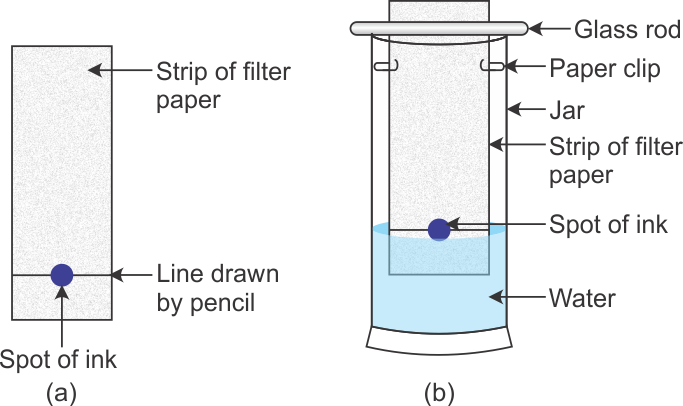
Observation: The results of the two colours blending together, it came to be successful. The black didn't stay as its colour it changed into multiple colours such as pink, light blue, orange, yellow, etc. My other colour which was dark blue actually went into a light blue instead of getting dark.
Conclusion: No my hypothesis wasn't right.
Hypothesis: What I think would happen once my colours are blending together, the outcome will straight away form into a darker colour.
Equipment: Felt Tip Pen, Filter Paper Strips, Test Tube, Measuring Cylinder, Pencil.
Method:
1. Draw a line across the filter paper in pencil, 5cm from the bottom.
2. Draw a coloured dot in the centre of the line.
3. Measure out 10mL of water and place in the test tube.
4. Place in the filter paper in the test tube and fold over the side. Make sure the pencil line is not in the water.
5. Wait for 5 minutes and observe the results.
Observation: The results of the two colours blending together, it came to be successful. The black didn't stay as its colour it changed into multiple colours such as pink, light blue, orange, yellow, etc. My other colour which was dark blue actually went into a light blue instead of getting dark.
Conclusion: No my hypothesis wasn't right.
Monday, February 17, 2020
Solubility Dissolving Experiment
Aim:
To see if salt or baking soda dissolves more
Hypothesis:
I think that the baking soda will dissolve more because powder is thinner and can disappear quickly when it is dissolving in a liquid, in my opinion.
Equipment: A 250 mL beaker, 100 mL measuring cylinder, salt, baking soda, a stirring rod, a teaspoon and a ruler.
Method:
1. Fill the beaker with 100 mL of tap water.
2. Add a level teaspoon of baking soda. A level teaspoon is obtained by running your ruler across the edges of the teaspoon).
3. Stir the solution until all of the baking soda has dissolved.
4. Repeat steps 2 and 3 until no more baking soda and then it will dissolve into the solution.
5. Record how many teaspoons of baking soda were added.
6. Repeat the experiment, with the table salt.
Results:
Discussion:
This experiment involved dissolving a solute. The first substance we dissolved was table salt, the results we got came upto 5 teaspoons and i'm pretty happy of how many teaspoons we did. Our results means that the mixture of salt and water can dissolve really well together.
For our second experiment, this time we did a mixture of baking soda and water, the results we got came upto 2 teaspoons. Our result means that the mixture of baking soda and water can not combine very well together.
Conclusion:
My hypothesis that I thought would combine together well was baking soda, but I found out at the end of my results was wrong. The table salt dissolved more in the water than the baking soda and had more teaspoons displayed. I thought that the baking soda would dissolve more because its particle size was much more smaller than the table salt.
To see if salt or baking soda dissolves more
Hypothesis:
I think that the baking soda will dissolve more because powder is thinner and can disappear quickly when it is dissolving in a liquid, in my opinion.
Equipment: A 250 mL beaker, 100 mL measuring cylinder, salt, baking soda, a stirring rod, a teaspoon and a ruler.
Method:
1. Fill the beaker with 100 mL of tap water.
2. Add a level teaspoon of baking soda. A level teaspoon is obtained by running your ruler across the edges of the teaspoon).
3. Stir the solution until all of the baking soda has dissolved.
4. Repeat steps 2 and 3 until no more baking soda and then it will dissolve into the solution.
5. Record how many teaspoons of baking soda were added.
6. Repeat the experiment, with the table salt.
Results:
Discussion:
This experiment involved dissolving a solute. The first substance we dissolved was table salt, the results we got came upto 5 teaspoons and i'm pretty happy of how many teaspoons we did. Our results means that the mixture of salt and water can dissolve really well together.
For our second experiment, this time we did a mixture of baking soda and water, the results we got came upto 2 teaspoons. Our result means that the mixture of baking soda and water can not combine very well together.
Conclusion:
My hypothesis that I thought would combine together well was baking soda, but I found out at the end of my results was wrong. The table salt dissolved more in the water than the baking soda and had more teaspoons displayed. I thought that the baking soda would dissolve more because its particle size was much more smaller than the table salt.
Subscribe to:
Posts (Atom)